
Over the past three academic cycles, the global landscape for Indian international students has experienced unprecedented turbulence. Traditional anchor destinations—including Canada with its enrollment caps and GIC hikes, Australia with its Evidence Level 3 restrictions, and the United Kingdom with dependent bans and surging salary thresholds—have introduced severe regulatory frictions.
Amidst this global reshuffle, Ireland has quietly positioned itself as the most strategic, high-ROI destination in Europe. As the sole native English-speaking nation remaining in the European Union and the Eurozone, Ireland offers Indian tech, engineering, business, and healthcare graduates direct access to a booming €500+ billion knowledge economy anchored in Dublin's world-famous Silicon Docks.
In this investigative advisory blueprint, the BharathRise Immigration & Academic Strategy Team delivers an end-to-end breakdown of the Irish higher education system: decoding the Stamp 2 Study Visa application, navigating the €10,000 liquid funds requirement, optimizing the 2-year Stamp 1G post-study work authorization, meeting updated 2026 DETE CSEP salary guidelines, and executing a seamless transition to Stamp 4 Permanent Residency.
1. Why Ireland is Dominating Indian Student Mobility in 2026
Ireland’s appeal to ambitious Indian students is rooted in structural economic advantages that no other European or Western country can match simultaneously:
1. The 1-Year Master's Advantage
Unlike the United States or Canada where Master's degrees require 24 months, Irish universities offer intensive, industry-focused 12-month Master of Science (MSc) and MBA programs (NFQ Level 9). This cuts your living expenses in half and allows you to enter the workforce a full year ahead of your peers.
2. The Only Native English Hub in the EU
While countries like Germany or France require students to master local languages (German B2/C1 or French) to secure competitive corporate roles, Ireland operates 100% in English across corporate boardrooms, legal contracts, tech documentation, and daily social life.
3. European Corporate Headquarters
Ireland hosts the European, Middle Eastern, and African (EMEA) headquarters for 9 of the world’s top 10 tech companies (Google, Meta, Microsoft, Apple, Amazon, LinkedIn, TikTok, Stripe) and 9 of the top 10 global biopharma giants (Pfizer, Novartis, J&J, Roche, Boston Scientific).
4. Bilateral UK & EU Settlement Rights
Under the historic Common Travel Area (CTA) agreement, Irish citizens hold the statutory right to live, work, study, and access healthcare in the United Kingdom without any visa, alongside full freedom of movement across all 27 EU nations.
Planning your university shortlist for the upcoming September or January intakes? Connect with our senior European mentors via the BharathRise University Admission Support Desk.
2. Ireland's National Framework of Qualifications (NFQ) & Post-Study Work Visas
Before applying to an Irish institution, Indian students must understand Ireland’s National Framework of Qualifications (NFQ). Your NFQ level directly governs whether you receive 1 year or 2 years of post-study work rights under the Third Level Graduate Programme:
| NFQ Level | Degree Classification | Standard Course Duration | Stamp 1G Work Rights Duration | Recommended For |
|---|---|---|---|---|
| NFQ Level 8 | Higher Diploma / Honours Bachelor's Degree | 3 to 4 Years (1 Year for Conversion H.Dip) | 12 Months (1 Year) | Undergraduate students and career-switchers taking tech conversions. |
| NFQ Level 9 | Master’s Degree (MSc / MA / ME / MBA / MEng) | 1 Year (Full-Time) | 24 Months (2 Full Years) | Primary Target for Indian Graduates: Maximum ROI and longest job search runway. |
| NFQ Level 10 | Doctorate (PhD) | 3 to 4 Years | 24 Months (2 Full Years) | Academic researchers, clinical scientists, and R&D specialists. |
3. Decoding the 2026 Critical Skills Employment Permit (CSEP) Salary Shift
The Stamp 1G is designed as a transitional bridge. Your ultimate goal while on Stamp 1G is to convert to a formal work permit. In Ireland, the premier work permit is the Critical Skills Employment Permit (CSEP), governed by the Department of Enterprise, Trade and Employment (DETE).
The Updated 2026 Minimum Annual Remuneration (MAR) Thresholds
DETE has adjusted minimum salary benchmarks to protect local wage standards and reflect inflation. Here is the exact legal salary breakdown:
| Permit Classification | 2026 Minimum Salary Required | Eligibility Criteria | Path to Stamp 4 PR |
|---|---|---|---|
| Critical Skills Graduate Rate | €36,848 / year | Recent graduate from an Irish institution (within 12 months of graduation) with a job offer in an eligible Critical Skills Occupation. | Fast-track 21 Months |
| Standard CSEP (With Degree) | €40,904 / year | Professionals holding a recognized degree with a job offer in a Critical Skills Occupation. | Fast-track 21 Months |
| General Employment Permit (GEP) | €34,000 / year | Non-critical roles. Requires employer to conduct a Labor Market Needs Test (advertising role for 28 days). | Standard 5 Years |
| High Earner CSEP (All Occupations) | €68,911 / year | Any occupation (except those on the Ineligible List), regardless of degree qualification. | Fast-track 21 Months |
4. Critical Skills Occupations List (CSOL): Where the High-Paying Jobs Are
The Critical Skills Occupations List is DETE’s official catalog of high-demand roles experiencing acute domestic talent shortages. Graduating in these domains virtually guarantees sponsorship eligibility:
- Information & Communications Technology (ICT): Software Development Engineers (Java, Python, C++, Go), Cloud Architects (AWS, Azure, GCP), Data Engineers & BI Specialists, AI/Machine Learning Researchers, Cybersecurity & Threat Intelligence Analysts, DevOps Engineers, and Network Infrastructure Architects.
- Life Sciences, Biopharma & MedTech: Quality Assurance (QA) & Quality Control (QC) Analysts, Process Validation Engineers, Bioprocess Chemists, Regulatory Affairs Associates, Formulation Scientists, and Biomedical Instrumentation Engineers.
- Engineering & Built Environment: Electrical & Electronic Engineers, Automation & Robotics Specialists, Mechanical & HVAC Engineers, Structural Engineers, and Renewable Energy Project Consultants.
- Finance & Professional Services: Chartered Certified Accountants (ACCA / ACA), Quantitative Risk Analysts, Actuaries, Tax Specialists, and Compliance Managers in International Banking.
Ensure your Statement of Purpose reflects clear alignment with Ireland’s critical skills needs. Explore our comprehensive SOP & Profile Building Consultation.
5. The Fast-Track PR Blueprint: From Stamp 2 to Irish EU Citizenship
What makes Ireland profoundly superior to countries like the United States (where H-1B lottery backlogs span decades) is its clear, statutory pathway to permanent residence and citizenship:
The 4-Stage Irish PR & Citizenship Pipeline
Enroll in an accredited Level 9 Master’s program. Work up to 20 hours/week during semester (€12.70/hr min. wage) and 40 hours/week during holidays. Build industry networks in Dublin, Cork, or Galway.
Upon receiving official exam results, convert to Stamp 1G. Work full-time (40 hours/week) across Irish corporate employers without needing an employer visa sponsor. Secure an offer meeting CSEP salary criteria (€36,848+).
Once your employer files your CSEP, you receive Stamp 1 permission. Work continuously with your employer for 21 months. Upon completion, apply directly to ISD for Stamp 4. Stamp 4 frees you from all permit requirements—you can switch employers freely, launch a business, or work in any field.
After accumulating 5 years of reckonable residence (years spent on Stamp 1 and Stamp 4 count fully), apply for Irish Citizenship. Hold an Irish EU Passport conferring dual citizenship rights in both the European Union and the United Kingdom.
6. Top Irish Universities & Institutes: Ranking & Strengths
Ireland's higher education system consists of world-ranked traditional research universities and highly agile Technological Universities (TUs) renowned for co-op industry placements:
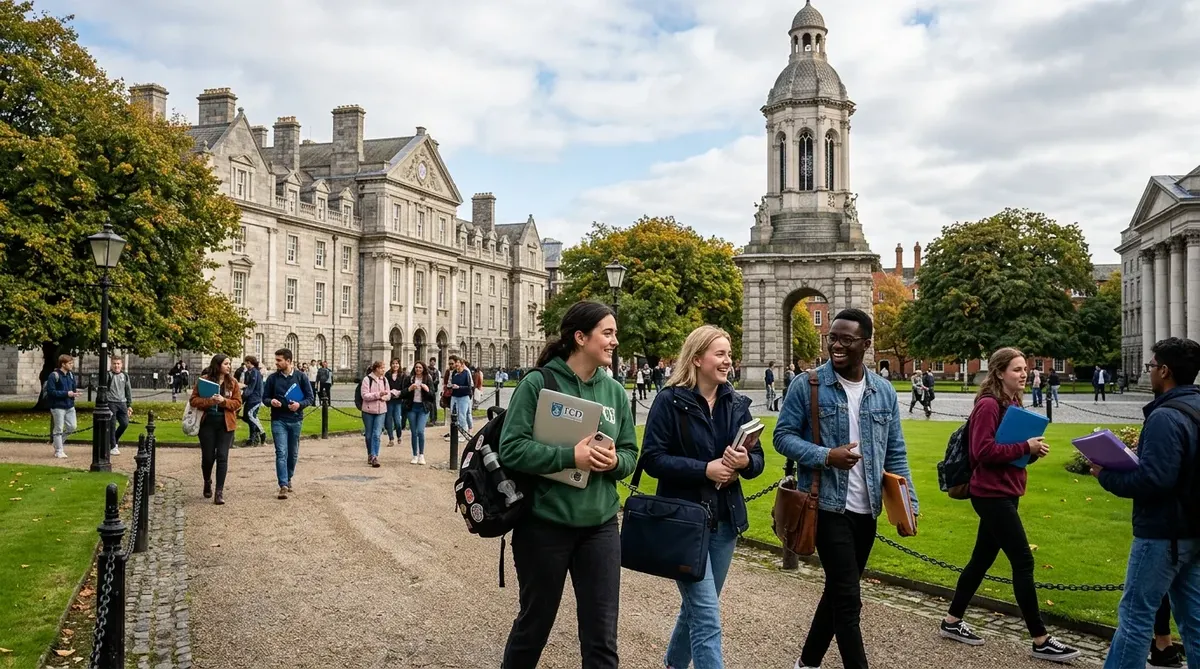
- Trinity College Dublin (TCD): Ireland's oldest and highest-ranked institution (QS Top 85). Renowned for computer science, bioengineering, business analytics, and immunology. Located in the heart of Dublin city center.
- University College Dublin (UCD): Ireland's largest university with the triple-accredited Smurfit Graduate Business School. Powerhouse in data science, civil engineering, digital policy, and finance.
- University of Galway: Global powerhouse for biomedical engineering, medical technology innovation, and environmental science. Strong tie-ins with Galway's medtech multinational cluster.
- University College Cork (UCC): World-leading research in food science, microbiology, pharmaceutical chemistry, and microelectronics (home to the world-renowned Tyndall National Institute).
- Dublin City University (DCU): Known as Ireland's "University of Enterprise." Pioneer in electronic engineering, artificial intelligence, and INTRA co-op internship programs with tech firms.
- University of Limerick (UL): Excellent campus infrastructure with high post-graduation employment rates in aeronautical engineering, supply chain management, and software design.
- Technological University Dublin (TU Dublin) & National College of Ireland (NCI): Located directly adjacent to Dublin’s International Financial Services Centre (IFSC) and Silicon Docks, offering top-tier Master's programs in Cloud Computing, Cybersecurity, and Data Analytics tailored specifically for enterprise placement.
7. Ireland Student Visa (Stamp 2) Financial Requirements & Step-by-Step Filing
Indian nationals require a Long-Stay 'D' Study Visa before traveling to Ireland. Visa applications are submitted via AVATS and processed through VFS Global centers in India (New Delhi, Mumbai, Hyderabad, Bengaluru, Chennai, Kolkata, Pune, etc.).
The €10,000 Financial Proof Mandate
Under Irish Immigration Service Delivery guidelines, you must prove that you can support yourself living in Ireland without relying on public funds:
- Liquid Living Funds (€10,000): You must show immediate, unencumbered access to at least €10,000 in liquid savings held continuously in bank accounts for at least 6 months, or through an approved education loan.
- Tuition Fee Payment Receipt: You must have paid your first-year tuition fees in full (or a minimum of €6,000 if your fees are higher, though 100% upfront payment is strongly recommended for 98%+ visa success from India).
- Electronic Transfer Receipt: Proof of fee transfer via recognized international transfer systems (e.g., TransferMate, PayToStudy, Flywire, or direct bank SWIFT transfer).
- Sponsor Financial Capacity: If parents are sponsoring living funds, provide 3 years of Income Tax Returns (ITR-V), bank solvency certificates, and a formal Letter of Financial Undertaking.
Need collateral or non-collateral education loan sanctions to cover your Irish tuition and €10,000 living expense proof? Access fast-track pre-approvals via our BharathRise Education Loan Assistance Desk.
Step-by-Step Irish Visa Filing Checklist
Step 1: Secure Unconditional Offer Letter & Pay Tuition
Obtain your formal offer letter from an eligible Irish institution listed on the Interim List of Eligible Programmes (ILEP). Remit your tuition fees and obtain your official Electronic Transfer confirmation.
Step 2: Obtain Private Medical Insurance
Non-EEA students must purchase valid private medical insurance covering hospital stays and medical repatriation up to €25,000 (often arranged directly through your university or providers like Irish Life Health / Vhi).
Step 3: Complete AVATS Online Application
Fill out the AVATS application form on the official Irish immigration website (visas.inis.gov.ie). Print the summary sheet and pay the visa fee (€60 single entry / €100 multi-entry).
Step 4: Draft a Compelling Statement of Purpose (SOP)
Your SOP must clearly demonstrate: (1) academic history and English proficiency, (2) why this specific Irish degree aligns with your career, (3) financial stability without recourse to public funds, and (4) commitment to abide by visa conditions.
Step 5: Book VFS Appointment & Submit Biometrics
Submit your original passport, educational marksheets, IELTS/PTE scorecard, financial portfolio, and biometrics at your local VFS Global center in India. Average processing times range from 4 to 8 weeks.
Global Destination Comparison: Ireland vs. UK, Germany, USA & Canada
How does Ireland hold up against competing study abroad destinations for Indian students in 2026?
- Ireland: 1-Year Master's, 2-Year Stamp 1G post-study work visa, €36,848 graduate CSEP salary threshold, fast-track 21-month Stamp 4 PR, 100% native English-speaking EU hub. Read our comprehensive guide on Studying in Ireland.
- Germany: Tuition-free public universities, €11,904 blocked account, 18-month jobseeker visa, German B2/C1 fluency typically required for top corporate integration. Explore our guide on 8 Low-Tuition Public Universities in Germany.
- United Kingdom: 1-Year Master's, 2-Year Graduate Route PSW, but high £38,700 Skilled Worker salary threshold, strict dependent ban, and post-Brexit exclusion from the European single market. Check our UK Graduate Route Visa Analysis.
- United States: 2-Year Master's, STEM OPT 36-month work permit, highest starting salaries globally, but mandatory in-person consular interview scrutiny and complex H-1B lottery bottlenecks. Read our US F-1 Visa Interview Waiver Rules & Approval Strategy 2026.
- Canada: CAD $23,448 GIC proof, strict college diploma CIP field restrictions, and national study permit allocation caps. Review our analysis on Canada Study Permit & PGWP 2026 Rules.